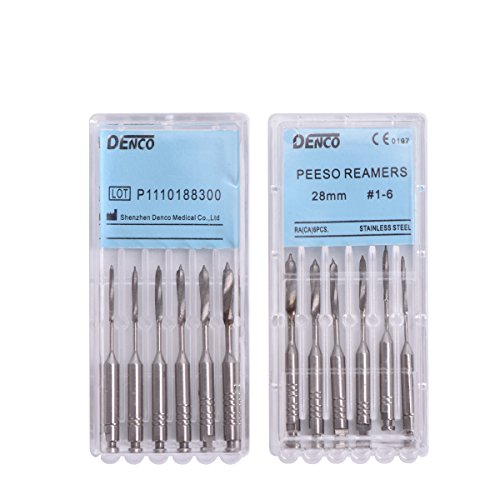
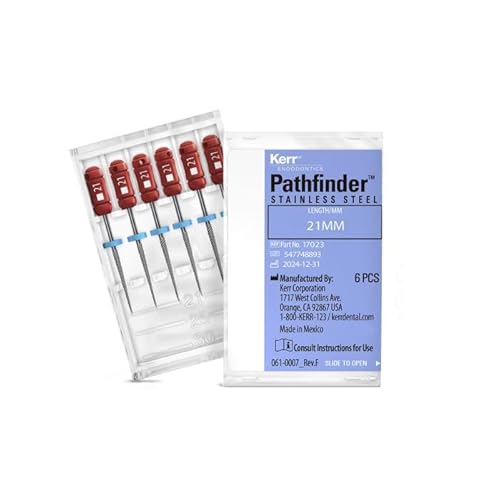
Selecting the right endodontic reamers is critical for efficient root canal preparation and ensuring the structural integrity of the tooth. This selection focuses on a variety of stainless steel instruments, ranging from Peeso reamers for coronal widening to fine needle files for apical shaping. Our evaluation prioritizes material durability, precision of the taper, and the balance between cutting efficiency and instrument safety.
Updated This Week
10
products
Interactive Comparison
As an Amazon Associate we earn from qualifying purchases.
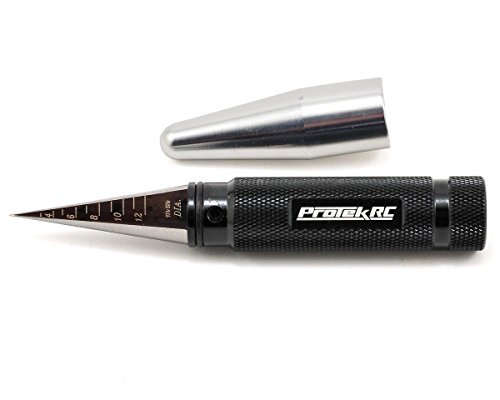
This body reamer features a double edged cutting head, with one side that displays inch increments up to a 1/2", while the other side has millimeter increments up to 12mm, and the head has an overall boar size of 0.60"/15.3mm. The double edge design makes it easier to keep the hole centered, and the measurements allow you to make precision sized holes in lexan/polycarbonate type material. Lastly, an o-ring in the handle is used to secure the cap, protecting you and the tool from damage or injury.
For most practitioners, a mix of high-quality stainless steel reamers and specialized Peeso tools provides the necessary versatility for the majority of endodontic cases.
Market Overview: endodontic reamers
AI
The market is currently split between affordable bulk stainless steel sets and high-precision, brand-name instruments designed for specific anatomical challenges.
Buying Guide: endodontic reamers
AI
When purchasing endodontic reamers, focus on the shaft length, the taper of the cutting head, and whether the tool is intended for hand use or engine-driven applications.
Selection Criteria
Products were selected based on clinical utility, material quality, user feedback regarding cutting efficiency, and overall value for the price.
Budget Advice
AI
Prices vary significantly: entry-level sets are highly affordable, mid-range options offer better precision, and premium instruments provide superior durability.
Conclusion: endodontic reamers
AI
Choosing the right tool depends entirely on the specific anatomy of the root canal you are treating. Whether you need bulk removal or fine shaping, we invite you to explore our full list to find the best fit for your practice.
Frequently Asked Questions
AI
Stainless steel is generally stiffer and better for creating a straight path or removing bulk material, while nickel-titanium is more flexible and better for curved canals.
Instruments should be replaced if you notice any signs of deformation, dulling of the cutting edges, or if the instrument feels excessively flexible, which may indicate fatigue.
Peeso reamers are designed for widening the canal orifice and removing coronal obstructions, whereas standard endodontic reamers are used for shaping the walls of the canal.
We use Google Analytics to measure site usage. In the EEA, UK and Switzerland, analytics cookies require your consent; without consent, only cookieless signals are sent. Elsewhere, measurement is enabled by default and you can decline. Declining does not limit access to the site.
Learn more