Selecting the right industrial timing belt provides the critical link between power transmission and mechanical precision. Whether you are maintaining a CNC machine, a 3D printer, or a heavy-duty industrial conveyor, the choice of material and tooth profile—such as HTD or XL series—determines the load capacity and slip-free performance. This selection focuses on durability, tooth geometry, and compatibility with standard pulley systems to ensure reliable, synchronous motion.
Updated This Week
10
products
Interactive Comparison
As an Amazon Associate we earn from qualifying purchases.
[Size] - Model Number: 450XL; Size: 1143mmx10mm / 45"x0.39" (LxW); Pitch: 5.08mm / 0.2"; Number of Teeth: 225
[Material] - The timing belt is made of high-quality rubber material, durable and flexible; Specially designed for linear motion, high positioning accuracy, excellent workmanship, and strong wear resistance
【High quality Materials】This HTD3M PU Open Ended Timing Belt made of polyurethane and reinforced steer wire, which can provide good durable and anti-corrosion property, it's absolutely stable and reliable in its quality;
【Product features】This HTD3M Synchronous Belt Compared with chain and gear transmission, the noise is lower, more suitable for noise-sensitive applications, its compact design, can maintain precise speed synchronization and realize accurate motion control;
8 Different Model Type : 1 x 4.33inch(110mm),1 x 4.27inch(112mm), 1 x 4.41inch(122mm),1 x 6.22(158mm),1 x 8.66inch(200mm) 1 x 11inch(280mm)1 x 11.8inch(300), 1 x 15.75(400mm) Timing Belts for you in daily used, 3d printer parts.
High-Material: Premium fiber reinforeced rubber, durable and flexible.
[Size] - Model Number: 320XL; Size: 812.8mmx10mm / 32"x0.39" (LxW); Pitch: 5.08mm / 0.2"; Number of Teeth: 160
[Material] - The timing belt is made of high-quality rubber material, durable and flexible; Specially designed for linear motion, high positioning accuracy, excellent workmanship, and strong wear resistance
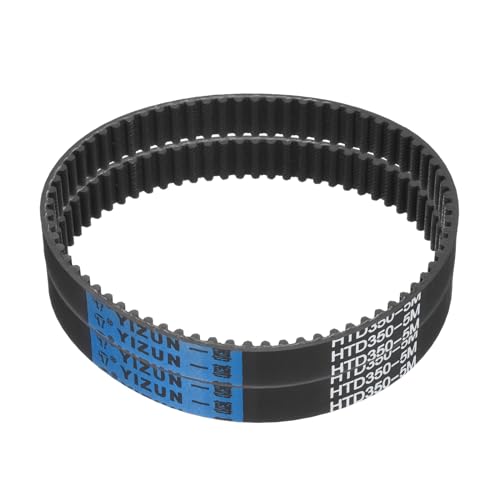
Size: HTD5M (High Torque Drive) timing belt with 350mm Pitch Length, 15mm Width, 3.6mm height. Curved shape for better power transmission and reduces the risk of slippage.
Belt Material: Timing belts are made of durable rubber (Neoprene) with reinforced nylon cords. These materials provide high tensile strength, flexibility, and abrasion resistance required for the belt to withstand the high temperatures and forces within the engine.
This list provides a balanced mix of versatile, high-precision belts. For those needing reliability in compact machinery, the HTD and XL series options here are the most dependable choices.
Market Overview: industrial timing belts
AI
The market is shifting toward high-precision, low-stretch materials to support the growth of 3D printing and desktop CNC machines, alongside traditional heavy-duty rubber belts.
Buying Guide: industrial timing belts
AI
When shopping for timing belts, prioritize the pitch, width, and material. Ensuring the exact match of the tooth profile to your existing pulley is the only way to guarantee synchronous motion.
Selection Criteria
Products were selected based on user feedback, material quality, tooth profile accuracy, and overall value for the price, focusing on light to medium industrial applications.
Budget Advice
AI
Prices vary significantly. Entry-level belts for small electronics are very affordable, while mid-range and premium industrial-grade belts cost more due to reinforced cores.
Conclusion: industrial timing belts
AI
Finding the right fit for your machinery is essential to avoid costly downtime. We invite you to explore our full list of recommended timing belts to find the exact specifications your equipment requires.
Frequently Asked Questions
AI
You must match the pitch (the distance between the center of one tooth to the next) and the tooth shape. Common profiles like HTD, GT2, and XL are not interchangeable; using a mismatched belt is the cause of most premature failures.
Rubber belts generally offer better grip and flexibility, while PU belts are more resistant to oil, water, and harsher chemicals, making them suitable for specific industrial environments.
Closed-loop belts are continuous loops for fixed-distance pulleys, while open-ended belts are used in systems where the belt is tensioned via a screw or a sliding mechanism.
Why Trust This List?
Data-Driven Selection
Analysis of 0 verified customer reviews
Regularly Updated
Last updated 2 months ago
Independent Analysis
Objective criteria: rating, price, popularity
Topelio participates in the Amazon Associates Program. We may earn commissions on purchases through our links, without affecting our recommendations.
We use Google Analytics to measure site usage. In the EEA, UK and Switzerland, analytics cookies require your consent; without consent, only cookieless signals are sent. Elsewhere, measurement is enabled by default and you can decline. Declining does not limit access to the site.
Learn more