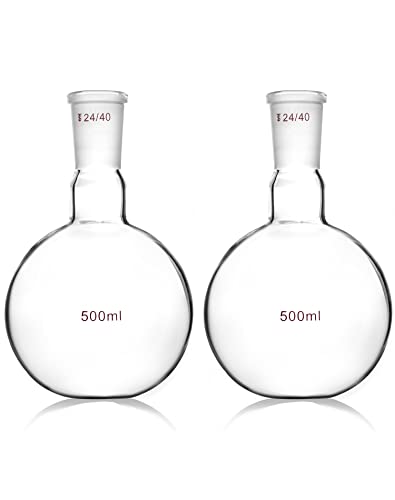
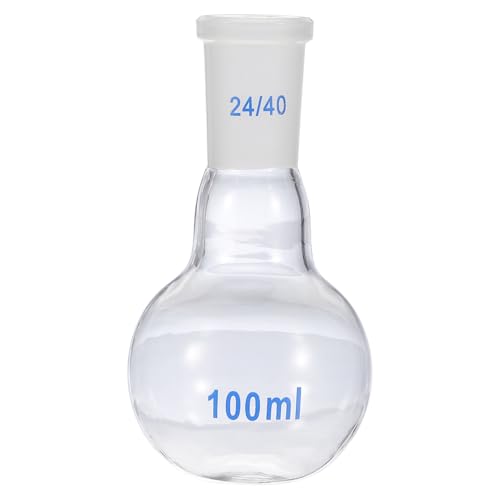
Selecting the right laboratory boiling flask is a matter of balancing thermal stability with practical handling. Whether you are performing a simple distillation or a complex chemical synthesis, the choice between flat-bottom and round-bottom designs significantly impacts your setup's safety and efficiency. Our selection focuses on borosilicate glass quality, joint standardization, and the durability of heavy-wall constructions to ensure reliable performance under heat.
Updated This Week
10
products
Interactive Comparison
As an Amazon Associate we earn from qualifying purchases.
Standard size: With 24/40 standard taper outer joint, 1000ml capacity.
Flat-bottomed flask: The flask can stand upright on a flat surface by itself, rather than on a flask holder or cork holder. Can be connected to laboratory glassware, with standard tape joints.
Standard size: With 24/40 standard taper outer joint, 1000ml capacity.
Flat-bottomed flask: The flask can stand upright on a flat surface by itself, rather than on a flask holder or cork holder. Can be connected to laboratory glassware, with standard tape joints.
Standard size: With 24/40 standard taper outer joint, 1000ml capacity.
Flat-bottomed flask: The flask can stand upright on a flat surface by itself, rather than on a flask holder or cork holder. Can be connected to laboratory glassware, with standard tape joints.
Advantage: The frosted 24/40 standard taper outer joint is easy to set up in the laboratory and simple to operate. Made of high temperature and corrosion resistant, strong 3.3 borosilicate glass. The flasks feature clear graduations for accurate volume measurement.
For most users, the QWORK and Labvida options provide the best balance of affordability and industrial-grade borosilicate quality, making them the most reliable choices on this list.
Market Overview: laboratory boiling flasks
AI
The market is currently shifting toward affordable, high-quality borosilicate sets that allow smaller labs and educational institutions to scale their equipment without massive investment.
Buying Guide: laboratory boiling flasks
AI
When shopping for boiling flasks, prioritize the glass grade and the joint type. Consider whether your workflow requires the stability of a flat base or the thermal distribution of a round base.
Selection Criteria
Products were selected based on material certifications (specifically borosilicate 3.3), user feedback regarding heat resistance, and price-to-volume value ratios.
Budget Advice
AI
Entry-level flasks are available for basic student needs, while mid-range options offer heavy-wall durability. Premium sets typically include precision-ground joints and bulk packaging.
Conclusion: laboratory boiling flasks
AI
Finding the right glassware depends on your specific volume requirements and heating method. Whether you need a single precision flask or a bulk set for a classroom, our curated list helps you decide. Explore the full range of options below to find your ideal match.
Frequently Asked Questions
AI
Flat-bottom flasks can stand on a benchtop without a support ring, making them convenient for simple heating. Round-bottom flasks distribute heat more evenly and are essential for vacuum applications, though they require a stand or clamp.
Borosilicate 3.3 glass has a very low coefficient of thermal expansion, meaning it is less likely to crack or shatter when subjected to rapid temperature changes compared to standard soda-lime glass.
This refers to the dimensions of the ground glass joint. The first number is the outer diameter in millimeters, and the second is the length of the joint. Standardizing these ensures compatibility with other lab apparatus like condensers.
We use Google Analytics to measure site usage. In the EEA, UK and Switzerland, analytics cookies require your consent; without consent, only cookieless signals are sent. Elsewhere, measurement is enabled by default and you can decline. Declining does not limit access to the site.
Learn more