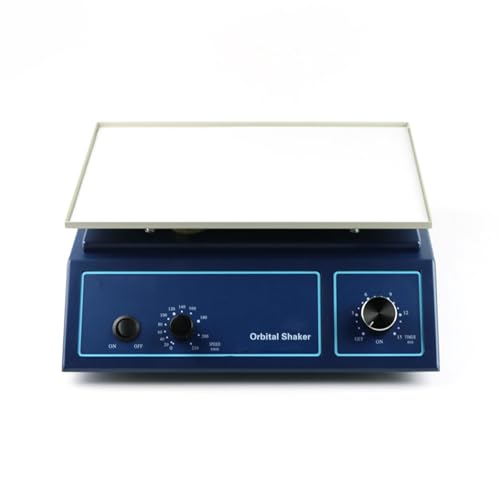
Selecting the right orbital shaker is critical for maintaining consistent mixing and aeration in laboratory samples. Whether you are managing cell cultures or chemical reactions, the balance between RPM stability and platform capacity determines your workflow efficiency. This selection focuses on a range of laboratory oscillating shakers, evaluating them based on speed precision, build quality, and the versatility of their mounting platforms to suit various container sizes.
Updated This Week
10
products
123-169€
Price Range
Interactive Comparison
As an Amazon Associate we earn from qualifying purchases.
Stable Performance: The orbital shaker is designed with eccentric ball bearings and a DC gear motor, which enables it to rotate and oscillate horizontally at a faster and more stable speed for more uniform mixing.
High Efficiency: The large workbench can process 2.2 lbs of sample mixing at once, improving work efficiency and saving you time.
Build to Last: It is mainly made of high-quality plastic, which is stable, durable, heat-resistant, rust-resistant, and has a long service life.
Stable Performance: The product is designed with eccentric ball bearings and a DC gear motor, which enables it to rotate and oscillate horizontally at a faster and more stable speed for more uniform mixing.
【ORBITAL SHAKING MOTION】Lab Shaker delivers 40-300 RPM. Choose between continuous mode (without limit) or 1min-99h59min timer mode. The 4.4lbs load capacity maintains stable shaking for various lab vessels. [Note]:The maximum load capacity of the orbital shaker includes the weight of the tray.
【LARGE LCD DISPLAY】Large LCD screen displays real-time RPM, timer status, and operating mode. It's facilitate to data recording and monitoring - perfect for multi-hour cell culture protocols.
Stable Operation: The orbital shaker is designed with eccentric ball bearings and a DC gear motor, which enables it to rotate and oscillate horizontally at a faster and more stable speed for more uniform mixing.
Efficient Mixing: The lab oscillator comes with a large work plate, which can process 2.2 lbs of sample mixing at once, improving work efficiency and saving you time.
STURDY CONSTRUCTION: This lab orbital shaker is built with high-quality plastic and features a durable dc gear motor, ensuring long-lasting performance, heat resistance, and stable operation for various laboratory environments.
STABLE MIXING PERFORMANCE: Equipped with eccentric ball bearings and a non-slip silicone pad, this horizontal shaker provides smooth and consistent circular oscillation, preventing sample slippage and ensuring uniform mixing every time.
Build to Last: The product is mainly made of high-quality plastic, which is stable, durable, heat-resistant, rust-resistant, and has a long service life. Easy Operation The intuitive user interface and detailed instruction manual allow you to master the usage and start your experimental operations faster.
Stable Performance: The product is designed with eccentric ball bearings and a DC gear motor, which enables it to rotate and oscillate horizontally at a faster and more stable speed for more uniform mixing. The four feet on the bottom can be fine-tuned to the height of different countertops for more stable operation.
For most basic lab tasks, the budget-friendly orbital shakers provide ample utility. However, for high-precision or high-volume work, investing in a 3D digital model is the only way to ensure consistency.
Market Overview: laboratory oscillating shakers
AI
The market is currently split between affordable, manual-control entry models and high-end digital 3D oscillators designed for complex university or industrial research.
Buying Guide: laboratory oscillating shakers
AI
When shopping for an orbital shaker, prioritize the maximum weight capacity, the precision of the speed adjustment, and the availability of timer functions for automated workflows.
Selection Criteria
Products were selected based on verified user feedback, price-to-performance ratio, and the reliability of speed control mechanisms.
Budget Advice
AI
Entry-level shakers are affordable for basic mixing, mid-range models offer better digital timers, and premium 3D oscillators represent a significant investment for specialized research.
Conclusion: laboratory oscillating shakers
AI
Finding the right balance between speed and stability can significantly improve your lab's output. We invite you to explore our full list of recommended orbital shakers to find the model that fits your specific technical requirements.
Frequently Asked Questions
AI
A 2D orbital shaker moves in a circular or elliptical motion on a flat plane, while a 3D shaker incorporates a tilting or waving motion, which is often better for mixing viscous liquids or ensuring complete aeration.
Low RPMs are typically used for delicate cell cultures to avoid shear stress, while higher RPMs are necessary for rapid chemical mixing or dissolving solids in a solvent.
Yes, especially for high-speed oscillations. Without a secure grip or anti-slip pad, containers can migrate across the platform, potentially leading to spills or uneven mixing.
We use Google Analytics to measure site usage. In the EEA, UK and Switzerland, analytics cookies require your consent; without consent, only cookieless signals are sent. Elsewhere, measurement is enabled by default and you can decline. Declining does not limit access to the site.
Learn more