Securing glassware is a fundamental requirement in any laboratory setting, whether for professional research or home science projects. Selecting the right laboratory rubber stoppers requires a balance between material durability, precise tapering for a tight seal, and size versatility. This selection focuses on sets that provide a wide range of diameters and specialized options, such as self-healing ports, to ensure safety and efficiency during chemical transfers and storage.
Updated This Week
10
products
9-9€
Price Range
Interactive Comparison
As an Amazon Associate we earn from qualifying purchases.
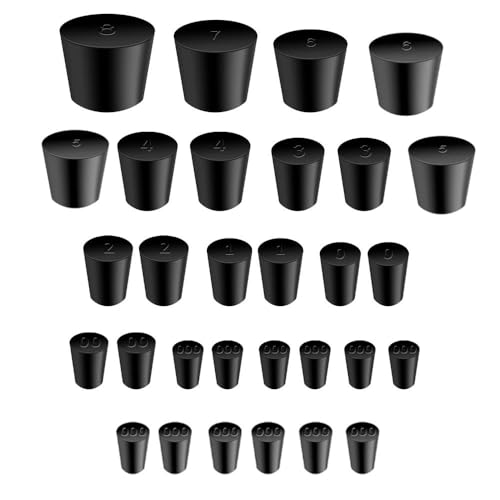
Complete Size Range: Includes #000, #00, #0, #1, #2, #3, #4, #5, #6, #7, #8. Each size #000 12 pieces (from #00 to #6) comes with 2 pieces, plus 1 piece each of #7 and #8
Premium Rubber Material: Made of high-density, durable rubber offering excellent resistance against non-aggressive chemicals and concentrated solutions
Solid Rubber Stoppers: These black stoppers are made of high-quality rubber, which is very durable, not easy to deform, and has good sealing performance.
Rubber Stoppers Size:11 assorted sizes,000# 00# 0# 1# 2# 3# 4# 5# 6# 7# 8#,wide choice for your application.
For most users, an assorted tapered set is the most practical investment. However, for vial-based work, the butyl rubber options provide the necessary precision and sealing integrity.
Market Overview: laboratory rubber stoppers
AI
The market is split between bulk assorted kits for general education and high-precision, material-specific stoppers for pharmaceutical or chemical research.
Buying Guide: laboratory rubber stoppers
AI
When choosing lab stoppers, prioritize the taper accuracy and material grade. Consider whether you need a general-purpose kit or specialized self-healing ports for injection work.
Selection Criteria
Products were selected based on size variety, user feedback regarding seal tightness, material durability, and overall value for the quantity provided.
Budget Advice
AI
Entry-level assorted kits are very affordable. Mid-range options offer larger quantities or specialized materials, while premium sets focus on high-grade chemical resistance.
Conclusion: laboratory rubber stoppers
AI
Finding the right seal prevents contamination and accidental spills in your workspace. Whether you need a comprehensive assorted kit or specialized vial stoppers, our detailed breakdown helps you choose. Explore the full list to find the perfect fit for your glassware.
Frequently Asked Questions
AI
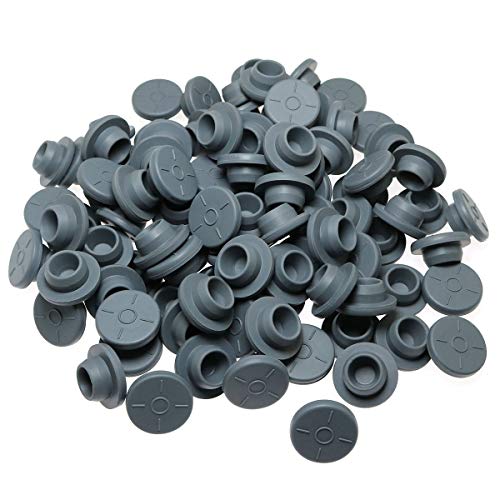
Tapered stoppers are cone-shaped, allowing them to wedge tightly into the neck of a flask or test tube. Mushroom stoppers have a flat top and are typically used for sealing vials or as injection ports.
Standard rubber is suitable for many applications, but it can degrade when exposed to certain organic solvents or strong acids. Always check the material compatibility (e.g., butyl rubber vs. natural rubber) with your specific reagents.
Lab stoppers are usually numbered (e.g., 000# to 10#). The best approach for general use is to purchase an assorted kit, which allows you to test different sizes against your specific glassware to find the most secure fit.
We use Google Analytics to measure site usage. In the EEA, UK and Switzerland, analytics cookies require your consent; without consent, only cookieless signals are sent. Elsewhere, measurement is enabled by default and you can decline. Declining does not limit access to the site.
Learn more