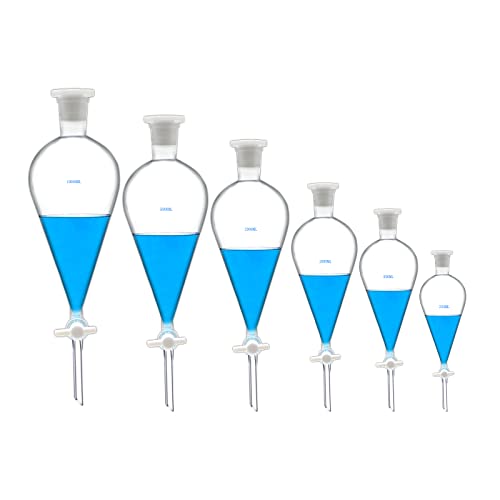
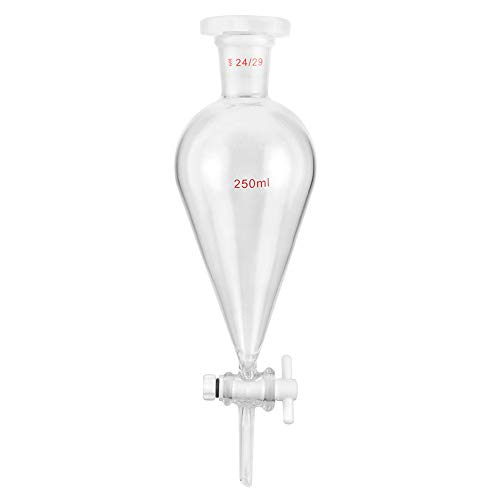
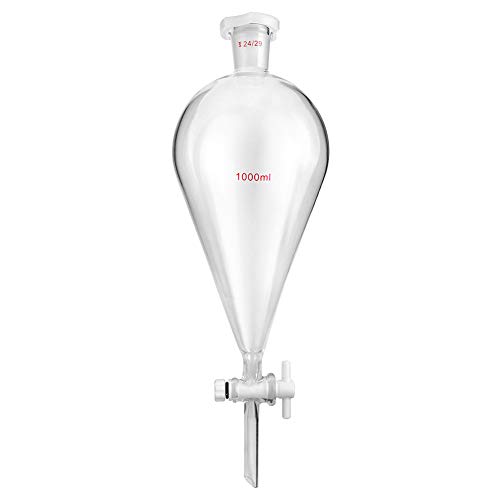
Selecting the right laboratory separating funnel is a matter of balancing precision, chemical resistance, and ease of use. Whether you are performing a simple liquid-liquid extraction or a complex organic synthesis, the quality of the stopcock and the thickness of the borosilicate glass can significantly impact your yield and safety. Our selection focuses on durability, joint compatibility, and the reliability of the sealing mechanisms to ensure a leak-free experience.
Updated This Week
10
products
Interactive Comparison
As an Amazon Associate we earn from qualifying purchases.
Precise Liquid Separation: This constant pressure liquid separation funnel features a tapered cylindrical design and standard stopper to accurately separate liquids of different densities, enhancing the efficiency of lab funnel applications in scientific experiments
Chemical Resistant Glass Material: Constructed from glass, this separatory funnel offers excellent resistance to corrosion and chemical reactions, making it suitable for handling various lab chemicals without degradation
Designed for precise liquid separation in laboratories, ideal for separating immiscible liquids with different densities in chemical and research applications
1000mL capacity with a conical design to ensure efficient phase separation, providing accurate and controlled liquid dispensing
For most users, a borosilicate funnel with a PTFE stopcock offers the best balance of longevity and purity. The QWORK and FSLAB options stand out for their reliability.
Market Overview: laboratory separating funnels
AI
The market is shifting toward PTFE-based valves over traditional glass ones to eliminate contamination and maintenance issues, with a strong emphasis on heavy-wall durability.
Buying Guide: laboratory separating funnels
AI
When shopping for separating funnels, prioritize the stopcock material, the total capacity, and the joint dimensions to ensure compatibility with your current lab setup.
Selection Criteria
Products were selected based on material quality, user feedback regarding leak prevention, price-to-performance ratio, and the inclusion of essential support hardware.
Budget Advice
AI
Entry-level funnels are affordable for basic tasks, while mid-range and premium options offer larger capacities, reinforced glass, or bundled support racks.
Conclusion: laboratory separating funnels
AI
Choosing a funnel that matches your specific volume and joint requirements will save time and reduce frustration in the lab. Explore our full list of top-rated separating funnels to find the best fit for your workstation.
Frequently Asked Questions
AI
PTFE (Teflon) stopcocks are generally preferred because they do not require grease to create a seal, reducing the risk of sample contamination and preventing the valve from seizing over time.
Check your existing laboratory glassware (such as flasks or adapters). Common sizes include 24/29 and 24/40; ensuring these match is critical for a secure, airtight fit.
Yes, borosilicate glass is the industry standard because it resists thermal shock and is highly resistant to chemical corrosion, making it safer for handling volatile solvents.
We use Google Analytics to measure site usage. In the EEA, UK and Switzerland, analytics cookies require your consent; without consent, only cookieless signals are sent. Elsewhere, measurement is enabled by default and you can decline. Declining does not limit access to the site.
Learn more