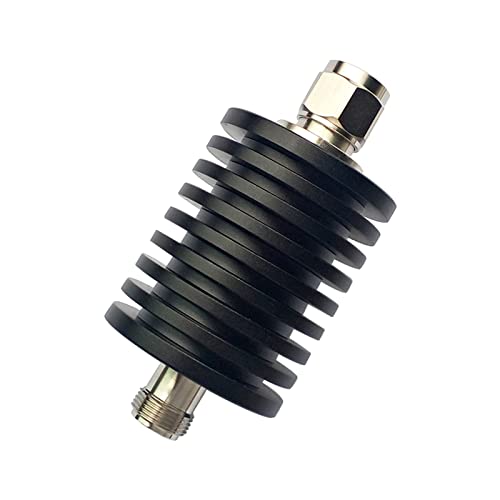
Selecting the right radio frequency attenuator is critical for protecting sensitive receiver equipment and ensuring signal accuracy during testing. Whether you need a fixed reduction for a permanent setup or a variable step attenuator for ham radio experimentation, the choice depends on power handling and frequency range. This selection focuses on reliability, connector compatibility, and the balance between precision and cost.
Updated This Week
10
products
10-35€
Price Range
Interactive Comparison
As an Amazon Associate we earn from qualifying purchases.
High Frequency Range & Compatibility: Covers DC to 250 MHz with precise 0 – 82 dB attenuation in 1 dB steps, making it suited for ham radio transmitter setups requiring accurate signal control over a wide operating spectrum.
Eight Section Step Design: Features 8 selectable attenuation stages (20 dB / -20 dB / -20 dB / -10 dB / -6 dB / -3 dB / -2 dB / -1 dB) for flexible configuration, adapting easily to varying transmission power and station requirements.
[HIGH FREQUENCY ATTENUATOR] Crafted from materials, this 50 OHM attenuator provides reliable performance for radio transmitters and other applications.
[VARIABLE ATTENUATION RANGE] Features an adjustable attenuation range from 0 to 82dB in 1dB steps, allowing precise control over signal levels.
attenuator , high stability : the radio frequency attenuator has excellent electrical performance making minimal change due to temperature . and carbon film has good uniformity and consistency , stableand high reliability
good workmanship circuit board : the 50 rf attenuator is made of fr 4 board , 30db attenuator sma , variable attenuator sma , aluminum electrolyte capacitor , high concentration tin , smt components , high power transistor
【SMA Double Female Head】 RF Interface: SMA Double Female Head (Outer screw inner hole). Carbon film has good uniformity and consistency, stable and high reliability.
【Improve impedance matching】 If some circuits require a relatively stable load impedance, an attenuator can be inserted between this circuit and the actual load impedance to buffer the impedance change.
【Wide Attenuation Range】The high frequency attenuator features a wide range of attenuation, from 0 to 82dB, with a step size of 1dB. This allows for precise and customizable signal adjustment to meet the specific needs of your radio transmitters and other applications.
【Construction】Made of and practical materials, this attenuator is designed to withstand the rigors of daily use. Its sturdy construction ensures reliable performance and long-lasting durability, providing you with a dependable solution for your signal attenuation needs.
APPLICATION RANGE: RF Attenuator Module is a wideband 6-bit digital attenuator for a wide range of RF and IF applications with an attenuation range of 0 to 31.5 dB and a typical step error of ±0.25 dB.
HIGH PERFORMANCE: Radio frequency attenuator replacement is available in a QFN surfaces mount package, uses a single 5V supply, operates from DC to 3.8 GHz and has an insertion loss of less than 2.0 dB (typical) and an IIP3 of +54 dBm.
For most ham radio and lab users, a variable step attenuator offers the best versatility, though high-power fixed units remain the safest bet for transmitter protection.
Market Overview: radio frequency attenuators
AI
The market is split between low-cost fixed modules for hobbyists and high-precision, digitally controlled attenuators for professional lab environments.
Buying Guide: radio frequency attenuators
AI
When shopping for RF attenuators, prioritize the power rating, frequency range, and impedance (typically 50 Ohm) to ensure compatibility with your signal chain.
Selection Criteria
Products were selected based on technical specifications, user feedback regarding signal stability, build quality, and overall value for the price.
Budget Advice
AI
Entry-level fixed attenuators are very affordable, while mid-range variable models and premium high-power N-connector units command a higher price point.
Conclusion: radio frequency attenuators
AI
Finding the right balance of attenuation and power handling ensures your equipment remains safe and your signals clean. Explore our full list of recommended RF attenuators to find the perfect match for your laboratory or radio shack.
Frequently Asked Questions
AI
Fixed attenuators provide a constant, predetermined level of signal reduction, while variable attenuators allow you to adjust the attenuation level manually or digitally to suit different testing scenarios.
Connector choice depends on your existing hardware. SMA is common for high-frequency electronics, BNC is standard for many lab instruments, and N-type connectors are typically used for higher power applications.
No. Exceeding the power rating of an attenuator can lead to overheating and permanent hardware failure. Always verify the wattage rating of the component matches or exceeds your signal power.
We use Google Analytics to measure site usage. In the EEA, UK and Switzerland, analytics cookies require your consent; without consent, only cookieless signals are sent. Elsewhere, measurement is enabled by default and you can decline. Declining does not limit access to the site.
Learn more